
Temu in 2026: What European SME Sellers Are Seeing and How to Sell on Temu from Shopify
Selling on a new marketplace is exciting… until operations get messy: overselling, stock mismatches, duplicate fulfillment work, and slower response times.
The good news: recent Temu SME research shared in European press releases points to real momentum for local sellers, especially around fast first sales, international reach, and operational growth– when the setup is done right. Below, we’ll summarize the key takeaways and share a practical “merchant playbook” for launching (or optimizing) Temu without adding daily chaos to your workflow.
If you’re on Shopify, we’ll also show how merchants use ToolE – Temu Easy Sync to keep inventory and orders aligned in one back-office.
What the Temu SME Insights Report 2026 suggests (Spain + Italy highlights)
Spain (seller-reported outcomes)
A Temu seller survey shared via Europa Press describes a fast ramp for many Spanish sellers:
- ~50% of surveyed sellers received their first order in 1–3 days
- 80% received their first order within a week
- 25% reported they had already expanded into new international markets
- 52% reported expanding some part of their business (catalog size, warehouse size, or staffing)

What this means for merchants: Temu can be a fast “demand test” channel, if you can fulfill reliably and keep inventory accurate from day one.
Italy (seller-reported outcomes)
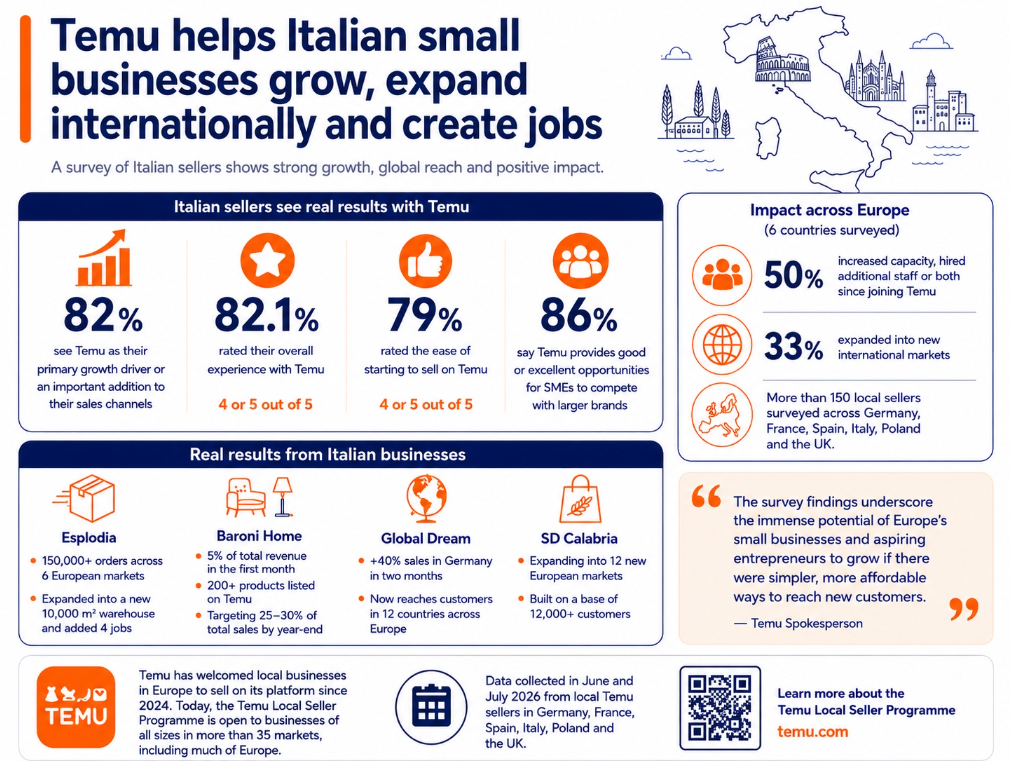
A Temu survey shared via ANSA (press release) highlights:
- 82% saw Temu as a primary growth driver or an important addition to their sales channels
- 68% expanded into new international markets
- 79% increased operational/production capacity
- 25% hired new staff
- 86% said Temu offers good/excellent opportunities for SMEs to compete with larger brands
What this means for merchants: expansion often becomes an operations problem before it’s a marketing problem. If you’re growing cross-border, you need rock-solid syncing and fulfillment workflows.
The Sell on Temu “merchant reality”: growth is great, but ops must stay simple
In our experience supporting merchants, Temu growth typically stresses the same three areas first:
- Inventory accuracy across channels (no overselling)
- Order speed + fulfillment SLAs (avoid late shipments and customer issues)
- Team workload (avoiding “double work” across multiple dashboards)
That’s why we built and keep improving our Shopify ↔ Temu connector.
The 7-step playbook to sell on Temu without losing control
1) Start with a clean Shopify catalog
Before connecting anything, make sure:
- SKUs are consistent (no duplicates, no “temporary” SKUs)
- Variant titles are clear (size/color)
- Product weights/dimensions are correct (for shipping accuracy)
- Barcodes/identifiers (if used) are consistent
Pro tip: If your team has “SKU drift,” fix it now. Product matching is always easier upfront than after your first 500 orders.
2) Decide how you’ll allocate stock to Temu
Most merchants need one of these strategies:
- Sell full available stock on Temu (simple, but riskier if you sell fast elsewhere)
- Reserve a buffer (e.g., keep 10–20% off Temu)
- Set channel caps for high-velocity items
ToolE helps merchants sync inventory and set rules for how much to sell on Temu vs. Shopify.
3) Centralize order management in Shopify (avoid dashboard hopping)
The operational goal is simple:
Temu orders should land in Shopify → you fulfill once → tracking updates back to Temu.
When everything flows through Shopify, your team/3PL can work in one place, with one pick/pack process, one set of automation rules, and one source of truth.
4) Install the ToolE Temu connector (Shopify App Store)
If you want to manage Temu alongside Shopify day-to-day, install:
ToolE – Temu Easy Sync: (Shopify App Store Link)
What merchants typically use it for:
- Import Temu orders into Shopify (including different Temu order types)
- Sync inventory between Shopify and Temu
- Fulfill/cancel/refund orders with tracking support (where applicable)
- Reduce manual work and keep customer experience consistent

5) Get your fulfillment workflow right (this is where metrics are won)
Pick one fulfillment path and standardize it:
- In-house fulfillment: define cut-off times + carrier mapping
- 3PL fulfillment: confirm how tracking is returned (and when)
- Multi-warehouse: decide which location fulfills Temu orders
Then test:
- One order end-to-end
- Tracking number behavior
- Refund/cancel flows
- Inventory deduction timing
6) Expand internationally with intention (not “everywhere at once”)
The temptation is to list broadly immediately. Instead:
- Start with your best-sellers (fast-moving, low return risk)
- Confirm packaging, translations, and expected delivery times
- Add markets once you’ve stabilized fulfillment and inventory accuracy
The Spain/Italy survey highlights international expansion, but the merchants who win long-term expand after operations are stable.
7) Monitor the right operational KPIs weekly
Don’t just track revenue. Track:
- % of orders shipped within your target window
- Cancellations due to out-of-stock
- Refund rate and top refund reasons
- Inventory mismatches (Shopify vs. Temu)
- Support contact rate per 100 orders
These are the levers that protect margins as volume grows.
Want to start selling on Temu?
If you’re ready to explore selling on Temu (and want a clear onboarding path), start here:
Start selling on Temu (Sell on Temu Link)
Growth is great: systems make it sustainable
Temu can be a powerful channel for discovering new customers and expanding cross-border, but the merchants who keep momentum are the ones who protect operations: clean SKUs, clear stock rules, and fulfillment managed in one place.
If you want to run Temu from Shopify with inventory and orders kept in sync, install ToolE’s Temu connector:
Temu Easy Sync: (Shopify App Store Link) and reach out to [email protected] for more info!