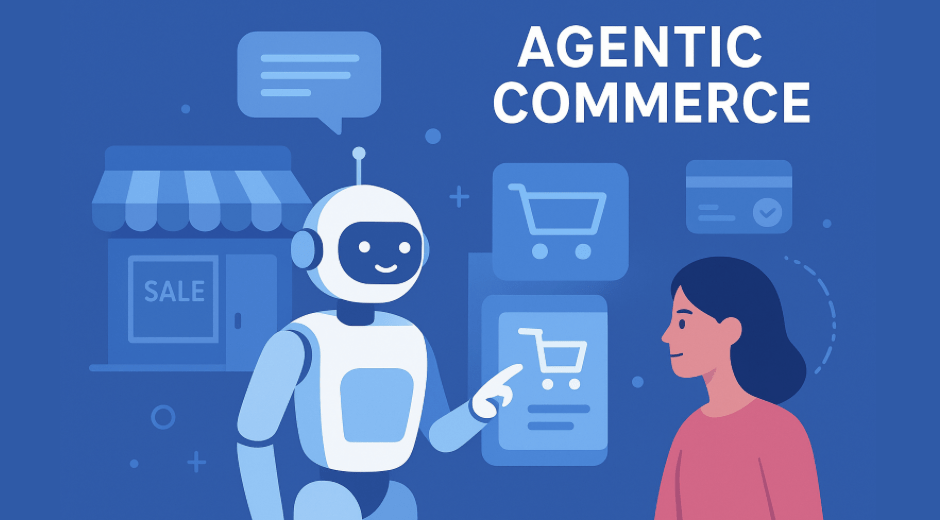
Agentic commerce is a new form of e-commerce where autonomous AI agents act on behalf of users or businesses. In practice, an agentic system might monitor your store, spot inventory needs or customer preferences, and even place orders or adjust pricing automatically. Think of it as a 24/7 virtual assistant or personal shopper that can search, compare and complete purchases for you. These aren’t simple chatbots: they make high-level decisions, negotiate options, and execute complex tasks.
Agentic vs. Traditional eCommerce and AI
Agentic commerce goes far beyond traditional e-commerce and basic AI automation. In a legacy store, customers browse and buy manually, and any AI (like chatbots or recommendation widgets) waits for input. By contrast, agentic AI is proactive and autonomous. An agent can plan ahead, adapt to changing data (inventory, pricing, trends), and carry out multi-step processes without constant prompts. For example, an agentic system might notice a slow-selling item and automatically devise a new promotion or reorder stock on its own. Agents don’t just answer your questions – they pursue goals for you.
This is more than the usual “AI automation” of today. Traditional AI tools (like a generative text generator or simple recommendation engine) still need human cues. In contrast, agentic AI sets its own objectives and executes them. The result is an e-commerce experience that feels effortless: customers delegate tasks (“Find me a budget-friendly gift for Dad”), and the AI does the heavy lifting of discovery, comparison and checkout on its own.
Real-World Impact: Shopify & Amazon Sellers
This future is arriving now, and it has big implications for sellers on platforms like Amazon and Shopify. For consumers, features like Amazon’s new “Buy for Me” showcase agentic commerce in action. A shopper can tell the agent, “Get me that blue jacket in size M,” and the AI searches Amazon (and even other sites), adds the item to cart and completes the transaction – all without manual navigation. This signals the end of the old “first click” advantage. Sellers may see less direct traffic and no-click sales delivered by agents.
On Shopify’s side, the platform is already equipping developers for agentic commerce. Shopify’s docs proclaim “Agentic commerce has arrived,” and describe new APIs (Catalog search, Universal Cart, Checkout Kit) that let any AI assistant shop across all merchants in Shopify’s ecosystem. This means a customer using an AI assistant could add products from multiple Shopify stores into one agent-managed cart. Amazon is not standing still either – its Seller tools are becoming agentic. For example, Amazon’s Seller Assistant now flags inventory issues and automatically adjusts pricing strategies before a seller even asks. This shift shows agentic AI moving “upstream” from customers to help sellers too. In short, agentic commerce is not a distant idea – it’s already rolling out. Sellers on these platforms should expect new AI-powered channels and consider how to get listed in the agents’ “shortlists.”
Emerging Tools & Trends in Agentic Commerce
Several cutting-edge tools and trends are fueling this shift. Large tech players are defining new standards. Google’s Agent-to-Agent (A2A) protocol and Anthropic’s Model Context Protocol (MCP) are open frameworks that let different AI agents share tasks and memory. These let a shopping agent delegate subtasks (like price checks or shipment updates) to specialized agents under the hood. Meanwhile, commerce-focused SDKs make it easier to build agents.
Major platforms and networks are launching agent-specific features. PayPal, Visa and Mastercard have rolled out agent-aware payment APIs (e.g. Visa’s Intelligent Commerce, Mastercard’s Agent Pay) so authenticated agents can complete purchases without human clicks. Shopify’s universal catalog and checkout kit (mentioned above) give agents a direct path to Shopify stores. On the marketing side, agent-based search and discovery are emerging: Google now offers AI-powered shopping summaries (“Overviews”) and Apple/Google are embedding AI assistants right into iOS and Android. Even Walmart is building multi-agent ecosystems across shopping and fulfillment.
One key trend is content and data optimization for AI. Agents rely on rich, structured data rather than catchy ad copy. For example, rather than “black sneaker,” use “black leather sneaker with white sole suitable for casual attire” and include all key specs. The more metadata (size, color, use-case, ingredients, etc.) you provide, the better AI agents can compare and choose your product. In sum, the technical groundwork for agentic commerce is here: APIs, protocols and AI agents are multiplying rapidly, and customer behavior is already shifting to favor AI-driven shopping.
Preparing Your Store for Agentic Commerce
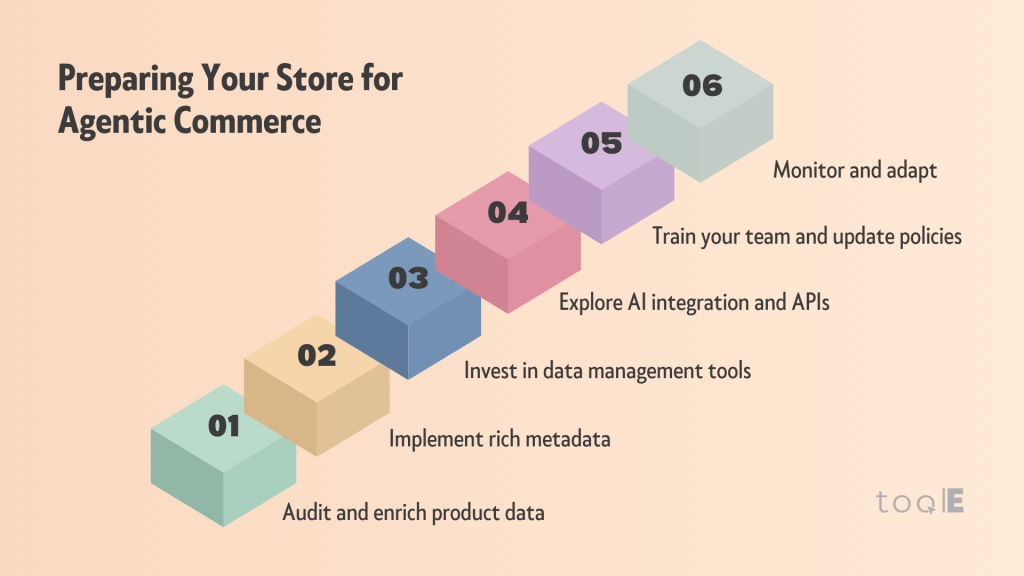
Forward-thinking sellers should act now to get ready. Key steps include:
- Audit and enrich product data. Conduct a thorough review of every listing. Ensure each SKU has complete, structured attributes (dimensions, specs, keywords, use-cases) so AI agents can discover and compare your products. This may mean adding new fields or standardizing categories.
- Implement rich metadata. Use Schema.org markup, detailed descriptions and annotated images. Agents don’t browse – they read data. Embedding structured tags for products and images will make your inventory “visible” to AI buyers.
- Invest in data management tools. AI agents process data at machine speed. Manual catalog maintenance won’t scale. Adopt a PIM or automated data-cleaning system that keeps information consistent across channels. Tools that bulk-update attributes or validate entries can pay off.
- Explore AI integration and APIs. Take advantage of early-agent programs. Shopify’s Agentic Commerce beta (Catalog & Checkout APIs) is open for developers. Consider enabling Shopify’s agent APIs on your store. Likewise, watch for agent-friendly checkouts (e.g. agents using PayPal or Amazon). Integrate chatbot/AI support tools now – even a simple 24/7 customer chatbot (common on Shopify) gets you familiar with agentic support.
- Train your team and update policies. Educate marketing and support teams about agent-driven buying. Update your return/refund policies to explicitly cover purchases made by AI agents. Decide what data you’ll share with third-party agents.
- Monitor and adapt. Agentic commerce is evolving fast. Follow industry updates (subscribe to newsletters or communities). Experiment with AI tools and pilot programs early. As agents become new “customers,” those who have invested in agent-friendly data and integrations will capture this traffic.
By starting these steps today, your store will be among the first wave to benefit from the agentic shift. Early adopters of AI agents often gain a competitive edge: better data leads to more agent referrals, which in turn drives higher sales.
Agentic commerce is no longer science fiction – it’s the next revolution in online retail. Retailers who adapt now will position themselves as favorites of tomorrow’s shopping agents. To keep ahead of this trend, subscribe to our blog for more AI commerce insights, and explore these new tools while the field is still wide open. Stay proactive, and let your AI agents work for you!