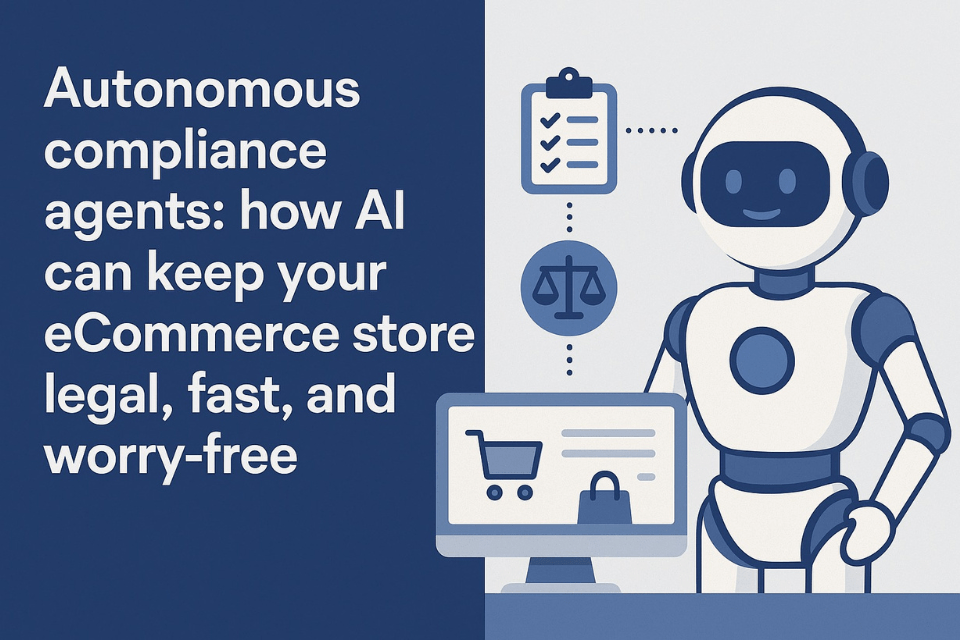
Ecommerce sellers are drowning in rules. From global privacy laws and state-by-state sales tax to accessibility standards, age verification, and green-marketing rules—compliance is a moving target. The good news: autonomous compliance agents—AI systems that monitor, interpret, and fix compliance problems automatically—are moving from enterprise labs into practical tools that even small merchants can use. This post explains what they do, why they matter, trusted sources to learn from, and a pragmatic roadmap for adoption.
What are autonomous compliance agents?
An autonomous compliance agent is software that continuously scans your store (pages, checkout flows, product data, marketing copy, cookies, and backend data flows), detects risks against relevant laws and standards, and either automatically remediates issues or produces actionable tasks for your team. That can include:
- updating privacy notices and cookie consent flows to match current regulations;
- flagging or fixing WCAG accessibility failures on product pages;
- applying the correct sales-tax logic per jurisdiction and filing returns (or handing the data to your tax partner);
- enforcing age verification for restricted goods;
- detecting environmental claims that might trigger regulator action and adding required disclosures.
These systems combine rules engines, ML classifiers, and integrations with compliance platforms so fixes happen in hours, not months.
Why this matters for ecommerce sellers
Compliance is no longer “legal theater” you can ignore. Noncompliance can mean heavy fines, forced remediation, suspended listings, or damage to customer trust. A few concrete pain points:
- Privacy: The EU’s GDPR requires lawful bases, data subject rights handling, and transparent processing—rules that apply to any seller targeting EU residents.
- US privacy (CCPA/CPRA): California’s rules give consumers rights over personal data and broad reporting/penalty powers—affecting many online sellers.
- Accessibility: WCAG standards are increasingly enforced; inaccessible checkout flows block customers and invite legal risk.
- Tax: Sales tax and marketplace-facilitator rules vary by state and country; automation saves hours and filing headaches.
- Environmental & marketing claims: Regulators (like the FTC) police misleading “green” claims—disclosures matter.
Autonomous agents reduce manual work, speed up fixes, and scale governance as your store grows.
Real components of an agentic compliance stack
Practical systems blend several layers:
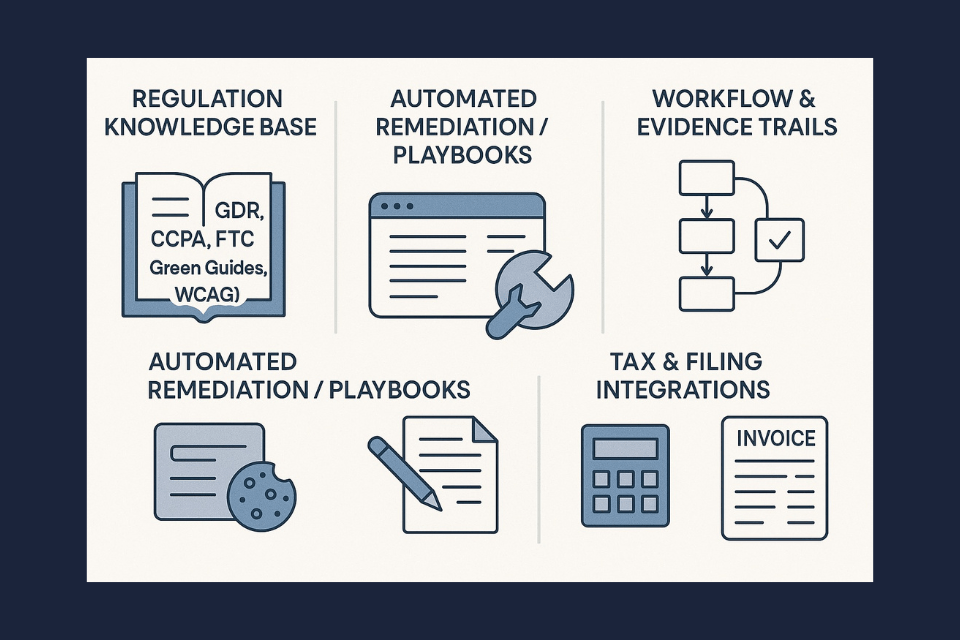
- Regulation knowledge base — canonical legal texts and regulator guidance (e.g., GDPR, CCPA, FTC Green Guides, WCAG). Agents map site issues to these rules.
- Site scanner + telemetry — crawls pages, cookies, APIs, invoice flows, and product metadata to detect gaps (e.g., missing cookie consent or inaccessible forms).
- Automated remediation / playbooks — scripted fixes (update banner copy, add alt text templates, insert mandatory disclaimers) that can be auto-applied or proposed for review.
- Workflow & evidence trails — audit logs, change history, and reports suitable for regulators or insurance claims.
- Tax & filing integrations — connect invoice and order data to tax engines that calculate, remit, and file, or prepare returns for accountants.
Industry players (tax engines, privacy platforms, accessibility scanners) are starting to add AI agents that orchestrate these pieces for merchants. Recent product announcements even show major tax vendors building autonomous agent features for ecommerce tax rules.
Use cases: what agents can actually do for your store
- Auto-update privacy banner & policies after you add a new marketing cookie or start selling into a new country. (Privacy agent)
- Patch accessibility issues by suggesting alt text, keyboard focus fixes, or even injecting interim ARIA attributes to maintain usability while engineering makes permanent fixes.
- Enforce age checks for restricted products by integrating identity/age-verification flows and blocking checkout unless verified—following regional rules (UK, EU, etc.).
- Detect risky green claims in product descriptions and add required FTC-style disclosures or edit copy to avoid deception.
- Calculate and file taxes using real-time tax rates, marketplace rules, and generate filing packages or automated filings.
Practical roadmap for adoption (for busy sellers)
- Map your compliance footprint — list the regions you sell into and the regulations that apply (privacy, tax, accessibility, age-restricted rules, environmental claims).
- Start with detection — deploy an accessibility scanner and a privacy/cookie audit. These quickly reveal low-effort, high-impact fixes.
- Plug in a tax engine — integrate a trusted provider for real-time tax calculations and filing automation (Avalara, Stripe Tax, TaxJar, etc.).
- Add an age-verification provider if you sell restricted goods—choose a compliant vendor for your jurisdictions.
- Automate playbooks — set policies for safe auto-fixes (e.g., auto-insert ‘limited claim’ disclosures) and tasks for human review on high-risk items.
- Keep an audit trail and conduct periodic manual legal reviews for new laws (agents reduce effort but don’t replace legal counsel).
Limits & compliance hygiene
Autonomous agents accelerate compliance but they’re not a magic shield. Agents depend on accurate data and up-to-date legal rules; high-risk decisions (complex contracts, litigation responses) still need lawyers. Think of agents as a force multiplier: they remove routine work and surface the truly hard issues.